

The Podcast Conundrum
How Pseudo-Experts Have Hijacked Podcast Land

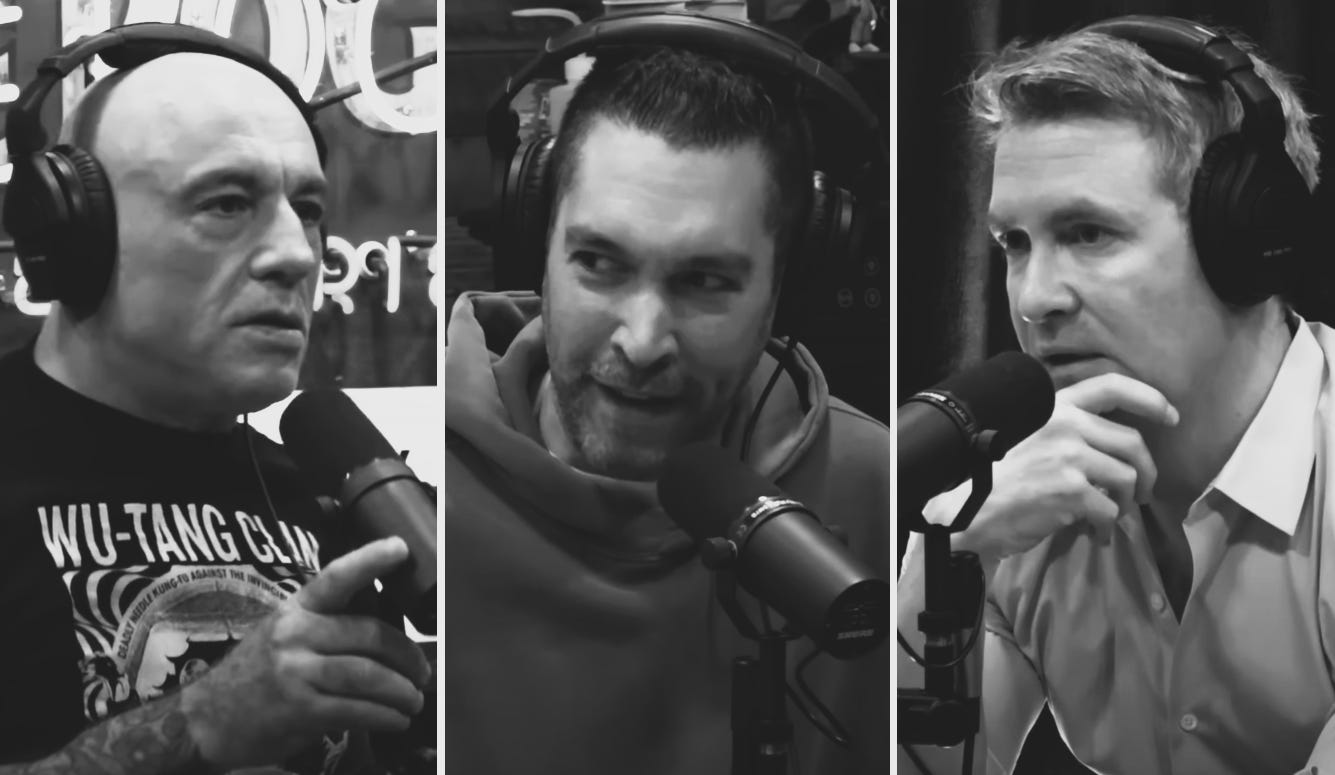
Recently, Douglas Murray and Dave Smith sat down for a conversation on the Joe Rogan Podcast. It was undoubtedly interesting, at times heated, but overall respectful - an essence that the online reaction seemed to miss in the aftermath.
One of the core aspects of the conversation that caused a lot of heat was the idea of the new expert class. This new expert class gained significant prominence during the COVID-19 pandemic, when catchphrases like “trust the experts” were used to encourage people to follow the advice of experts. The pandemic has been one example of how goodwill from the public has been used and abused by those in positions of authority. This results in a world where people feel that they can no longer trust the experts. Just like the story of the boy who cried wolf, repeated lies and mistakes over time cause people to stop listening altogether.
So, where does this leave us? A world without experts, or a world where experts are replaced? I would suggest that the latter half is truer. Today, more people are listening to new experts on podcasts and social media as the current expert class slowly fades away. This democratisation has meant that people who were once sidelined can now have a voice and freely criticise and debate. However, in this process, problems arise when real experts are replaced by pseudo-experts who seek to exploit this new environment for their own gain. This might not be altogether bad, but a problem arises when these alternate voices spread false narratives and go unchallenged.
The conversation between Douglas Murray, Dave Smith, and Joe Rogan mentioned a few of these pseudo-experts, the biggest of whom is Darryl Cooper. Darryl Cooper has never described himself as an “expert”; instead, he sees himself as a history lover who talks excessively about it, as Tucker Carlson described him as "America's most important popular historian.” So why are Darryl’s ideas so dangerous? In recent appearances on a plethora of so-called “right-wing” podcasts, Darryl has been seen spewing Nazi propaganda. Recently, in his appearance on Joe Rogan, Darryl expressed his view that Hitler was not openly anti-Semitic in his speeches before 1938. This statement is not true, as seen in his numerous speeches since the party's inception, including his own written work, Mein Kampf, and innumerable speeches such as Nuremberg in 1935 and the Reichstag Speech in 1933. Since the inception of the Nazi party, a core pillar has been its anti-Semitism, which was laid out in his first speech in 1920 outlining the 25-point program for the creation of the Nazi state. On the Tucker Carlson podcast, Darryl stated, “Churchill was the chief villain of World War 2,” further suppressing the crimes of the Nazis in an attempt to create a false moral equivalency. Darryl’s view of history shares similar framings with other debunked historians; his views on World War II echo the words of David Irving, whose ideas have been thoroughly debunked by scholars.
This industrial social media complex has created an environment where bad ideas spread like wildfire. Because of how social media algorithms work, bombastic and wildly inaccurate stories flourish, while authentic narratives are suppressed. In the case of Cooper, his opinion that Winston Churchill is “the chief villain of World War 2” serves as a more provocative analysis than the historical consensus held by nearly every historian since then. In arguing these points, a key criticism can be that such an argument is just one from authority. The argument from authority might look like this: because x is an expert, therefore x is right. The problem with this is twofold: first, x could be wrong; second, x may not have a consensus with y and z. Here arises the core problem: just because experts are experts, it doesn't mean they are always correct. The same can be applied to people like Darryl; just because he might challenge the mainstream narrative doesn't mean he's right.
Darryl serves as an example of what can go wrong when the experts are no longer trusted. The truth is, expertise does matter. We must test the knowledge and understanding of the expert class to come to accurate conclusions. Experts must also talk to experts; the consensus might not always be correct, and such ideas need to be challenged. This can be seen in history, with numerous experts debating issues such as history (as seen in the recent Israel-Palestine War), economic theory, archaeology, and theology, among others. Experts in the fields should be listened to; people don’t have to agree with them, but we cannot shut them out in such a critical time and replace them with reactionary podcast alternatives. In recent years, experts have been trying to amend their image to educate the public. In the field of history, experts like Niall Ferguson have been making well-reasoned historical arguments responding to Darryl's historical claims. When true experts can be questioned and tested, a healthier educational environment can emerge on the other side.
With the fall in trust of traditional media comes new media to replace the old. But is this new media better than the old? The answer to that is maybe. The reality is that the current media switch might be a case of 'garbage in, garbage out,' and it could get even worse. So, how can podcasting improve from here? Well, first things first, true experts must be listened to and platformed, and their ideas must be challenged. The same must be done with the new pseudo-expert class; they must be challenged in the same way the experts are challenged, and from there, the best ideas can win. The podcast landscape has brought about systemic changes in how we consume information. It has fundamentally changed the media landscape by promoting free speech and new ideas, so let’s not mess this up.
References:
PowerfulJRE. (2025, April 10). Joe Rogan Experience #2303 - Dave Smith & Douglas Murray. YouTube.
Tucker Carlson. (2024, September 2). Darryl Cooper: The True History of the Jonestown Cult, WWII, and How Winston Churchill Ruined Europe. YouTube.